
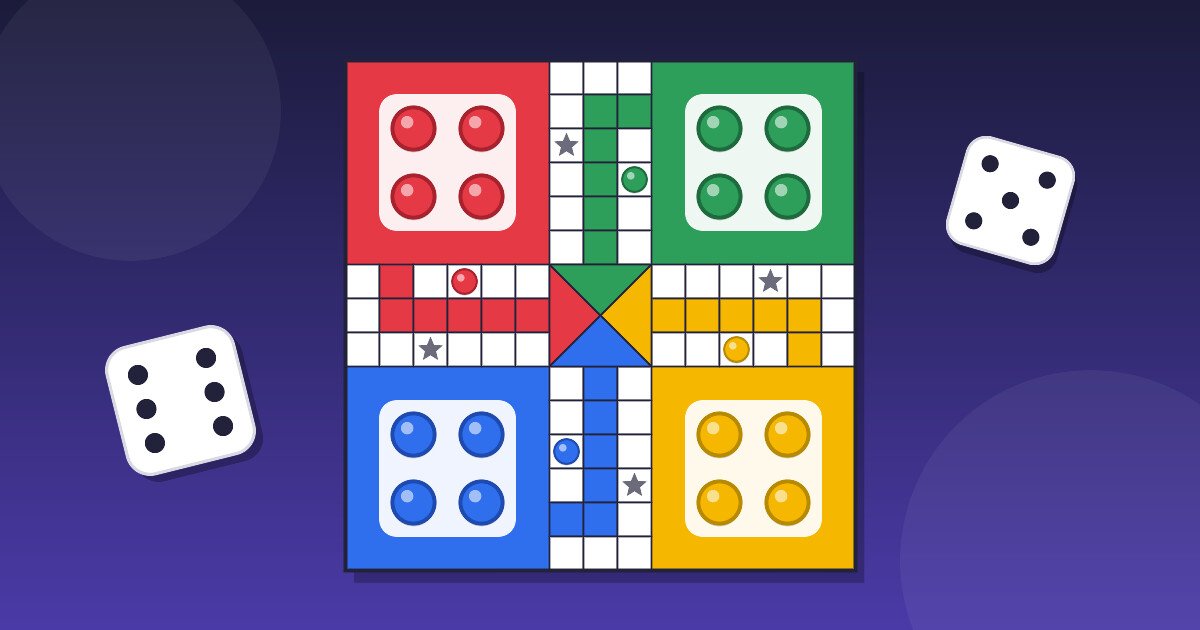
Knowing how to play Ludo takes about five minutes, but keeping the peace at the table takes a little longer. Almost every game ends the same way. Someone lands on someone else’s token, somebody says that shouldn’t count, and suddenly the whole table is arguing about a rule nobody agreed on at the start. The dice are simple. The house rules are what get complicated. This guide covers the standard rules, the variations that cause the most arguments, and a handful of habits that win more games than luck alone would.
How to play Ludo in short: it is a race for two to four players. Everyone has four tokens and the same goal, which is to get all four around the board and into the centre first. You need a six to leave your yard, you can send an opponent’s token back to the start by landing on it, and every six earns you another roll.
What You Need to Play
A board, one dice and four tokens per player in a single colour. The board has four coloured yards in the corners, a cross-shaped track that everybody shares, and a home triangle in the middle. Each colour has its own starting square on the track and a coloured lane that leads to the centre, which only that player can use.
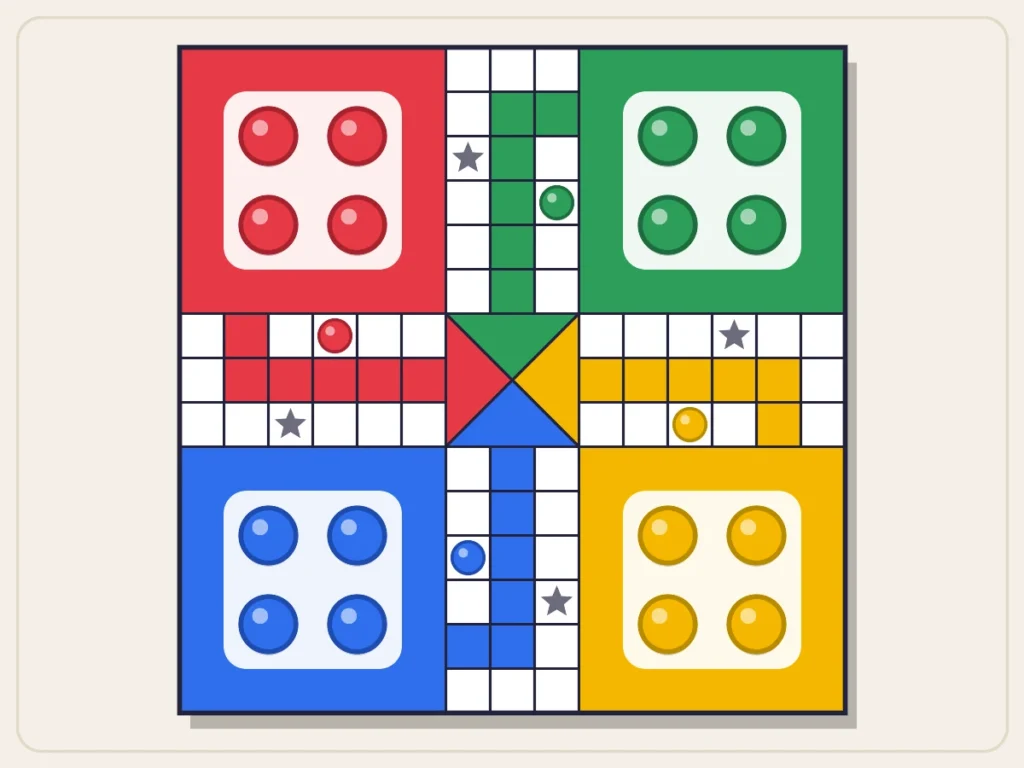
Ludo grew out of Pachisi, a race game that has been played in India for centuries. The dice-and-coloured-yards version most people know today was patented in England in the 1890s.
How to Play Ludo: A Turn Step by Step
Here is how to play Ludo, one turn at a time. Everyone rolls once to decide who starts, and the highest number goes first. After that, play moves clockwise around the table.
- Every token starts in the yard, and nothing moves until you roll a six. If you have no token on the track and you don’t throw a six, your turn simply passes.
- A six lets you move one token onto your starting square. It also gives you another roll straight away.
- Once a token is out, you move it clockwise by the number you roll. If you have several tokens in play, you choose which one moves.
- Landing on a square that holds a single opponent token captures it. That token goes back to its yard and has to wait for another six.
- Squares marked with a star, and each colour’s starting square, are safe. Nobody can be captured while standing on one.
- After a full lap, your token leaves the shared track and turns up your own coloured lane towards the centre.
- The first player to get all four tokens into the home triangle wins.
Rules That Change From Table to Table
This is where the arguments start, so before you teach anyone how to play Ludo, it pays to ask about these rules before the first roll.
- Exact roll to finish. Some groups make you throw the exact number to reach the last square. Others let any roll that gets you there count.
- Three sixes in a row. A lot of players cancel your turn if you throw three sixes back to back. Others let you keep going.
- Blockades. Two of your tokens on the same square can form a block that opponents cannot land on or pass. Some tables love this rule and some ban it.
- Captures on safe squares. Normally not allowed, but a few families play without safe squares at all.
- Leaving the yard. Classic Ludo needs a six. Some quick variants also let you start on a one.
Online games apply a single fixed set of rules automatically, so there is nothing to argue about. It is still worth playing a practice round to see which version you are dealing with.
How to Win More Often
Once you know how to play Ludo, the dice still decide your numbers. You decide what to do with them, and that is where good players pull ahead.
Get two tokens moving early
Leaving three tokens in the yard while you race one around the board feels efficient, but it gives you exactly one choice on every roll. With two tokens in play, a bad number can usually be spent somewhere harmless, and you are ready to punish an opponent who slips up.
Learn the one-in-six rule
If an opponent’s token sits one to six squares behind yours, they can hit you with a single roll, roughly a one in six chance. If they are seven to twelve squares behind, they need a six first and then the right number, which is closer to one in 36. Those figures assume a single chasing token, and every extra chaser adds risk. Still, they explain why stepping just out of range is often smarter than staying put.
Capture the token that has travelled furthest
Sending back a token that was three squares from home costs your opponent an entire lap. Sending back one that has just left the yard costs them almost nothing. When you have a choice of captures, take the one that hurts most.
Rest your leading token on a safe square
A token that has almost finished its lap is the most valuable piece you own, so treat it that way. If a star square is within reach and someone is close behind, stop there and let the danger pass.
Save your sixes for the right job
Beginners tend to use every six to run forward. A six is often worth more as a way to launch a new token or to make a capture that needs exactly that distance. The bonus roll comes either way.
Do not rush your last tokens
If your version needs an exact roll to finish, a token one square from the end can wait many turns for the right number. Bring a second token close as well, so that more rolls are useful.
Mistakes That Lose Games
The most common one is sending a single token far ahead of the pack. It looks brave, but it is alone, and any opponent sitting behind it gets a free shot every turn.
The second is not looking at the board. Before every move, count the squares between your token and any opponent behind it, the same way you would check your mirrors before changing lanes.
The third is the panic capture: hitting a token that has only just left the yard when a far more valuable capture was available.
How to Play Ludo Online
You do not need a board or a dice any more. Ludo With Friends runs in your browser with no download, and it offers a few different ways to play:
- A private room for friends or family, for two to four players, joined with a room ID
- Online matches against other players
- A computer opponent for practice
- Pass and play on a single device
If you are new to the game, play a match or two against the computer first. It is the cheapest way to see how captures, safe squares and the home lane behave in this version before you sit down with real people.
Ludo Dash is our other Ludo game, a faster and shorter take on the classic. It plays differently from the standard game, so read the short description on its page before your first round.
Ludo FAQ
How many people can play Ludo?
Two to four players.
Can two people play Ludo?
Yes. Most people sit in opposite corners so the board stays balanced, though some groups give each player two colours.
What is the easiest way to learn how to play Ludo?
Start with a practice match against the computer, or join a private room with a friend who already knows the rules. Watching a few turns teaches you more than reading about them.
Is Ludo luck or skill?
Luck decides the numbers, skill decides what you do with them. One game can go to the luckier player. Over a handful of games, the better decision maker usually comes out ahead.
What does the star square do?
It is a safe square. A token standing on it cannot be captured.
Can I play Ludo online for free?
Yes. You can play Ludo With Friends in your browser here without installing anything.
Now that you know how to play Ludo, grab a friend, set up a room and see who gets all four tokens home first.
